
Article: Macle Diamonds: The Hidden Crystal Architecture Behind Nature’s Triangular Diamonds
Macle Diamonds: The Hidden Crystal Architecture Behind Nature’s Triangular Diamonds
A Diamond Shape That Tells a Deeper Story
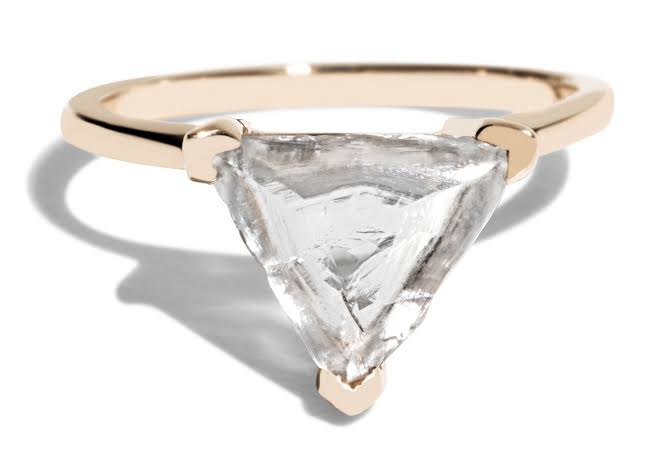
Most people picture a diamond as a sparkling octahedron in its natural state or a precisely faceted gemstone ready for jewellery. Yet nature produces crystals with far more unusual geometries. Among them is the macle diamond, a naturally twinned crystal recognised for its distinctive flattened, triangular appearance.
Unlike a conventional diamond crystal, a macle forms when two diamond crystal structures meet along a specific crystallographic plane. This contact-twinning process creates a shape that can be remarkably thin and broad, with edges and corners that reflect the complex conditions under which the crystal grew deep within the Earth.
For gem enthusiasts, macle diamonds offer more than an unconventional silhouette. Their external form preserves clues about the forces and conditions that shaped them over geological time.
A study by gemologist Ahmadjan Abduriyim and crystallographer Masao Kitamura, published in the Gemological Institute of America’s Gems & Gemology journal in Fall 2025, provides new insight into this process. By examining both the outer surfaces and internal growth zones of natural macle diamonds, the researchers revealed how two distinct corner-growth mechanisms influence their final shape.
What Is a Macle Diamond?
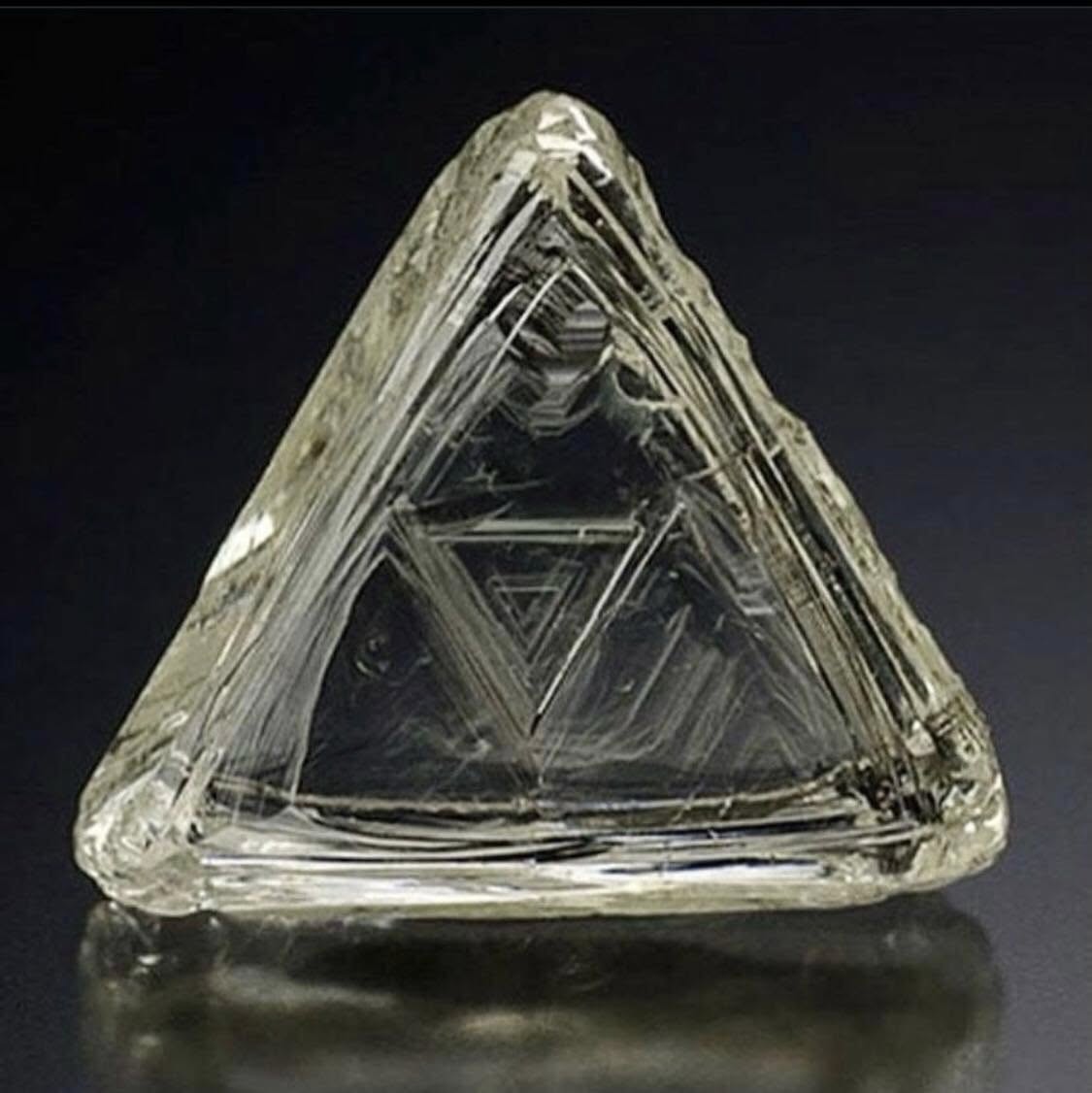
The word macle comes from French and refers to a twin crystal. In diamond crystallography, it describes a contact-twinned crystal formed by two octahedral diamond structures joined along an octahedral {111} plane.
This arrangement produces the characteristic triangular outline and flattened profile associated with macle diamonds. Some specimens have pronounced concave corners, while others develop pointed or convex corners as growth layers accumulate.
The 2025 GIA study examined 14 natural rough macle diamonds from South Africa. The specimens ranged from 0.118 to 0.747 carats and displayed colours from colourless to light yellow and very light pink. Their shapes varied considerably, demonstrating that crystals sharing the same fundamental twinning relationship can develop very different external forms.
Dissolution can also alter their appearance after growth, softening sharp edges and rounding corners. Consequently, the shape visible today reflects not only the crystal’s original growth process but potentially later changes to its surface.
What makes macle diamonds particularly interesting is that their triangular form is not simply a geometric consequence of twinning. It is also a record of how the crystal grew.
The Science Behind the Shape: Two Types of Corners
To understand why macle diamonds become flattened, researchers examined the behaviour of different crystal faces near the twin boundary. Their study focused on two types of corners: re-entrant corners and salient corners.
✨ Explore Diamond Options Designed to Last
Speak with our team on WhatsApp
or Book a private consultation in Hong Kong
Re-entrant corners: Where growth can accelerate
A re-entrant corner is a concave junction created where the twinned crystal faces meet. In crystal growth, this geometry can provide favourable sites for additional growth, allowing material to accumulate more rapidly near the junction.
This phenomenon is known as the re-entrant corner effect. It has long been used to explain why twinned crystals can develop distinctive shapes that differ from those of ordinary single crystals.
In macle diamonds, preferential growth around these concave corners can gradually alter the original outline. As new growth layers accumulate, the indentation may become less pronounced, eventually transforming into a pointed or apex-like corner.
Salient corners: The other side of the story
A salient corner is the outward-projecting junction on the opposite side of the corner geometry discussed above. Although previous explanations of macle morphology placed considerable emphasis on re-entrant corners, the GIA study investigated whether salient corners also experience preferential growth.
The results showed that they do.
Growth at salient corners can contribute to the development of thick layers along the twin boundary and influence how broadly the crystal expands. Although this effect does not necessarily dominate growth at re-entrant corners, it helps explain why some macle diamonds become significantly flatter than others.
The key finding is that a macle’s distinctive shape cannot be fully explained by one corner-growth mechanism alone. Both re-entrant and salient corners play a role in determining its final morphology.
Four Morphological Groups Reveal Different Growth Histories
The researchers classified the observed crystals into four morphological groups according to the shape of their re-entrant corners and the development of their growth layers.
Group I — Relatively simple triangular forms
These crystals feature comparatively flat octahedral faces and concave re-entrant corners. Their surfaces show relatively limited development of thick growth layers around the twin boundary.
Group II — Concave corners with additional growth layers
Group II crystals retain concave corners, but several stacked growth layers appear around the twin boundary. These layers indicate a greater degree of modification during crystal formation.
Group III — Thick growth layers and small concave corners
In Group III, substantial growth layers accumulate around the twin boundary, producing high-index crystal faces described by the crystallographic notation {hhk}. Small concave corners remain visible, but the surrounding surfaces have become more complex.
Group IV — Apex corners and highly flattened forms
Group IV represents the most striking transformation. The original concave corners may become completely covered by smooth or stepped high-index surfaces, leaving convex apex corners instead. Some specimens are exceptionally flat and elongated.
The study reported Groups III and IV as newly documented morphological categories in its analysis of natural macle diamonds. Their significance lies in demonstrating how accumulated growth layers can reshape a crystal so extensively that its original corner geometry is no longer visible.
The fascinating world of natural gemstones


Reading a Diamond’s Growth History from Within
A diamond’s external shape reveals only part of its history. To investigate how macle diamonds change as they form, the researchers examined the crystals’ internal growth zoning.
Four specimens were cut, polished and analysed using scanning electron microscopy with cathodoluminescence imaging, commonly abbreviated as SEM-CL. This technique helps reveal variations within a crystal that are not necessarily visible from its exterior.
The resulting images showed successive growth bands, allowing the researchers to reconstruct changes in crystal morphology over time.
The observed pattern suggested that macle diamonds initially developed with re-entrant corners. As growth continued, these corners could gradually transform into apex corners through the accumulation of layers. Later growth could partially cover the apex with additional crystal faces, producing the flattened triangular forms seen in the finished rough crystals.
In some specimens, the growth pattern changed repeatedly rather than following a single uninterrupted progression. This finding provides an important insight: the final shape of a macle diamond can preserve evidence of multiple stages of crystal growth, not just one defining event.
The research therefore connects visible geometry with the microscopic architecture hidden inside the crystal.
✨ Explore Diamond Options Designed to Last
Speak with our team on WhatsApp
or Book a private consultation in Hong Kong
Carbon Supersaturation: Why Growth Conditions Matter
One of the study’s most important conclusions concerns carbon supersaturation, a condition in which the growth environment contains more dissolved or available carbon than would be present at equilibrium under the relevant conditions.
The degree of supersaturation affects how readily new material joins a growing crystal and where new growth begins.
Under relatively low carbon supersaturation, growth may favour particular energetically favourable sites associated with crystal faces, corners and dislocations. These conditions can make preferential growth at re-entrant and salient corners more influential.
At higher supersaturation, new growth layers may form more readily across a wider range of surface locations. This can reduce the relative importance of the corner effects that help produce characteristic macle shapes.
By measuring the widths of internal growth bands, the researchers inferred that carbon supersaturation did not remain constant throughout the growth of the studied crystals. Instead, it appeared to increase and decrease at different stages.
Their findings suggest that comparatively thin, flattened macle diamonds with apex corners may form under lower carbon supersaturation conditions than thicker triangular crystals with pronounced concave corners.
These interpretations are based on the studied specimens and the researchers’ growth model; they should not be treated as a universal rule for every natural diamond.

Why Macle Diamonds Matter to Gem Enthusiasts
Macle diamonds illustrate how a gemstone’s appearance can reflect a complex geological history. Their triangular outlines, unusual corners and internal growth bands are not arbitrary features. They are physical evidence of the processes that shaped the crystal.
For collectors and jewellery designers, this natural variation offers a different way to appreciate diamonds. The interest lies not only in brilliance or conventional proportions, but also in the individual geometry of a crystal and the history it may preserve.
For jewellery, a distinctive rough crystal can also inspire designs that emphasise asymmetry, natural contours or unusual settings. Whether a particular rough diamond is suitable for a finished piece depends on its dimensions, quality, structural characteristics and the intended design.
At Mangrove Diamonds, understanding a diamond begins with appreciating the characteristics that make each stone distinct. From selecting a diamond for a classic ring to exploring a bespoke design, informed choices start with the stone itself and the qualities that matter most to the wearer.
Explore Mangrove Diamonds: Discover our jewellery collection or learn about our custom jewellery service.
A Small Crystal With a Remarkable Story
Macle diamonds remind us that nature rarely follows a single, simple pattern. Their flattened triangular forms emerge from the interaction of crystal geometry, preferential growth at different corners and changing conditions during formation.
By combining surface observations with internal growth-zone analysis, the 2025 GIA study offers a more complete explanation of how these unusual diamonds develop. Its central insight is that both re-entrant and salient corners contribute to the evolution of macle morphology, while fluctuations in carbon supersaturation help explain changes throughout the growth process.
For anyone fascinated by the science behind gemstones, a macle diamond is more than an unusual piece of rough diamond. It is a natural record of crystal growth, preserved in a shape that can be read, studied and appreciated.

Discover a diamond chosen for your story. Explore Mangrove Diamonds or contact our team to discuss a personalised jewellery design.
Further Reading
For the original scientific research, read the GIA article: External Morphology and Internal Zonal Structure of Macle Diamond, by Ahmadjan Abduriyim and Masao Kitamura, published in Gems & Gemology, Fall 2025.
Read more

Can Infrared Spectroscopy Reveal Whether a Sapphire Has Been Heat-Treated?
A sapphire's beauty is immediately visible. Its treatment history, however, may require considerably more sophisticated investigation. Heat treatment is widely used in the gemstone industry to modi...
Read more