

An Unconventional Bead-Cultured Saltwater Pearl
Pearls are often admired for what they reveal on the surface: their lustre, colour, shape and natural-looking texture. But for gemologists, some of the most important clues are hidden deep inside.
A recent examination at the GIA laboratory in Mumbai demonstrates just how challenging modern pearl identification can become. The specimen was an undrilled white semi-baroque saltwater nacreous pearl weighing 8.98 carats and measuring 11.31 × 10.75 × 10.30 mm.
At first glance, the pearl displayed dents and wrinkles reminiscent of cultured pearls. Yet its internal structure did not immediately match the familiar patterns expected from either natural or conventional cultured pearls.
Only through advanced X-ray imaging did researchers uncover evidence suggesting that this unusual specimen was most likely a bead-cultured saltwater pearl—but one created with an unconventional bead nucleus.

When a Pearl Looks Familiar—but Isn't
The pearl submitted to GIA was white, semi-baroque and undrilled.
Its surface showed dents and wrinkles that could easily be associated with cultured pearl growth. However, visual observation alone could not establish how the pearl had formed.
This distinction is fundamental in pearl identification.
Natural and cultured pearls can sometimes look remarkably similar from the outside. Their internal structures, however, may tell very different stories.
According to GIA, X-ray imaging is an important method for examining the internal structures of pearls because natural, bead-cultured and non-bead-cultured pearls can display different internal growth patterns. When conventional X-ray imaging is inconclusive, micro-computed tomography (μ-CT) can provide much more detailed three-dimensional information.
That was precisely the challenge presented by this unusual pearl.
The First Examination: Real-Time X-Ray Microradiography
The first major examination used real-time X-ray microradiography (RTX).
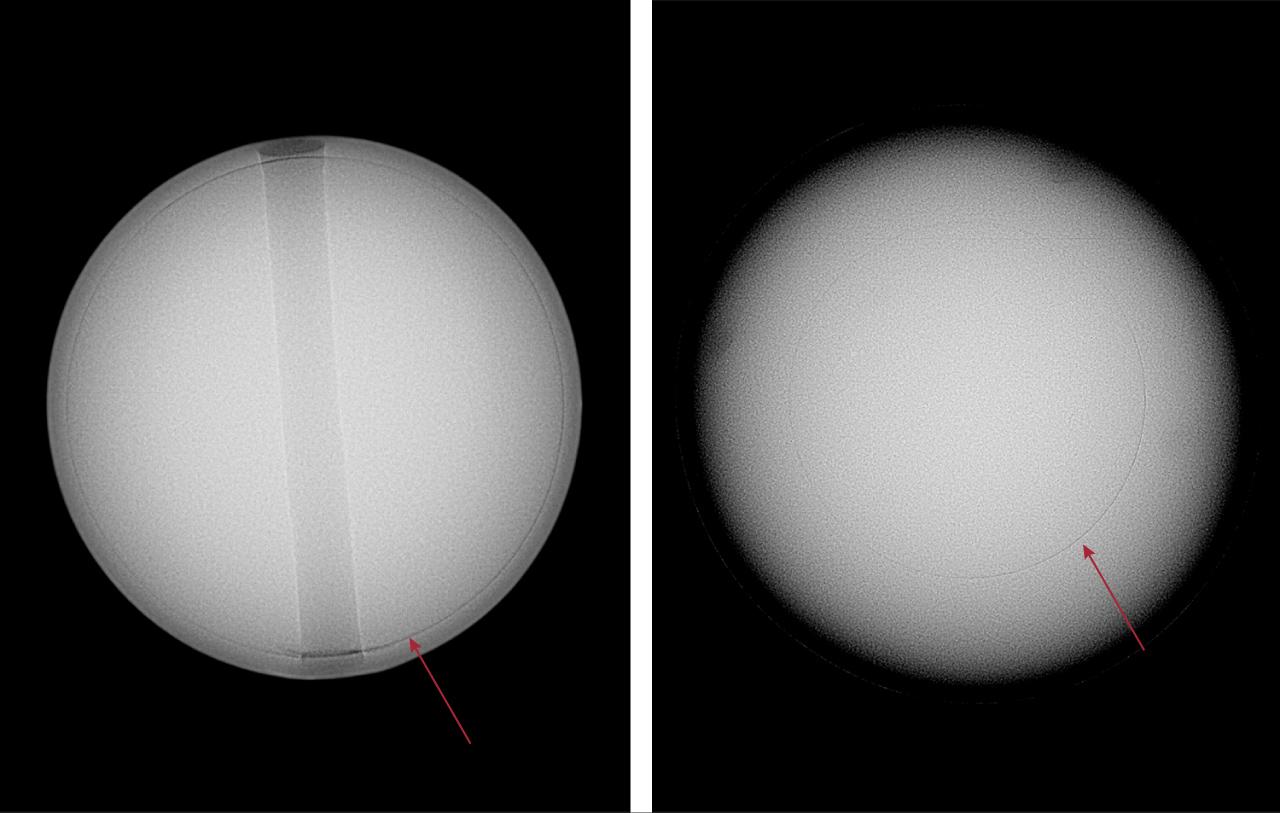
The technique revealed a remarkably tight internal structure with relatively uniform opacity throughout the pearl.
But there was a problem.
The researchers could not clearly identify the growth features normally expected from either a natural pearl or a conventional cultured pearl of this size.
In other words, the first X-ray image did not provide an obvious answer.
This is an important reminder that advanced gemological identification is rarely about finding one isolated characteristic. Instead, specialists combine several observations and analytical techniques to build a reliable identification.
μ-CT Reveals a Possible Bead Nucleus

μ-CT imaging can reveal internal pearl structures that may be difficult to interpret through conventional X-radiography alone. GIA research has demonstrated its usefulness in distinguishing natural, beaded cultured and non-beaded cultured pearls. GIA research on X-ray computed microtomography in pearls
The investigation continued with X-ray computed microtomography (μ-CT).
Unlike a conventional two-dimensional X-ray image, μ-CT reconstructs the internal structure of an object in three dimensions. This allows researchers to examine subtle changes in density, boundaries and growth structures from multiple directions.
In this case, μ-CT still revealed a tight internal structure.
But it also revealed something important: a fine, round demarcation that appeared to represent the boundary of a possible bead nucleus.
There was a subtle difference in radiopacity between this central area and the surrounding nacre.
That evidence suggested that the pearl was most likely bead cultured, although its internal structure was distinctly atypical.
GIA research has described μ-CT as a powerful tool for pearl identification, particularly when traditional X-radiography cannot clearly separate natural pearls from beaded and non-beaded cultured pearls.
What Makes a Typical Bead-Cultured Pearl Different?
In a conventional bead-cultured saltwater pearl, the internal structure is usually much easier to recognize.
A spherical bead nucleus is introduced during cultivation, and nacre is subsequently deposited around it.
On X-ray imaging, the bead generally produces a distinct internal boundary. Depending on the pearl and nucleus material, this boundary can appear as a relatively clear circular or dark-gray demarcation.
Some pearls may also show small organic gaps surrounding the nucleus.
The specimen examined in Mumbai was different.
Its internal opacity appeared much more blended and uniform. The possible bead nucleus also appeared more radiopaque than the freshwater shell material commonly used for traditional bead nuclei.
This raised another question:
What exactly was used as the nucleus?
An Unconventional Bead Nucleus?

The material used as a bead nucleus can influence how a cultured pearl appears under X-ray and other analytical techniques. Modern pearl cultivation continues to introduce increasingly unusual internal structures.
The material used as the nucleus can significantly influence how a cultured pearl appears during laboratory testing.
Traditional white saltwater bead-cultured pearls with sufficiently thick nacre may show a weak yellowish-green reaction under X-ray fluorescence because of trace manganese associated with freshwater shell material used for the bead nucleus.
The pearl examined in this case behaved differently.
It showed an inert reaction under X-ray fluorescence (XRF), supporting a saltwater origin.
At the same time, the absence of the expected fluorescence response suggested that the bead may not have been made from conventional freshwater shell material.
Researchers therefore considered the possibility of an unconventional nucleus, potentially including:
-
A saltwater shell bead
-
Another type of organic material
-
Another non-standard material developed for pearl cultivation
However, the exact material could not be confirmed.
This distinction matters. The investigation provided strong evidence that the pearl was likely bead cultured, but the precise identity of the bead nucleus remained inconclusive.
Why X-Ray Fluorescence Added Another Layer of Evidence
X-ray fluorescence provided an additional clue.
The pearl's inert reaction was consistent with a saltwater origin, helping researchers distinguish it from freshwater material.
But XRF also became useful when considered alongside the internal imaging.
The investigation effectively combined several independent observations:
External appearance → RTX imaging → μ-CT structure → XRF response
No single test completely solved the mystery.
Together, however, they produced a much stronger interpretation.
This is characteristic of modern gemological identification. Particularly unusual specimens may require several analytical techniques before a laboratory can reach a confident conclusion.
Why Modern Cultured Pearls Are Becoming Harder to Identify
Pearl cultivation technology continues to evolve.
As growers experiment with different nucleus materials, cultivation methods and techniques for producing unusual shapes and structures, the internal characteristics of cultured pearls can become increasingly difficult to distinguish from conventional examples.
GIA has noted that advances in pearl cultivation have made the distinction between natural and cultured pearls increasingly challenging, while μ-CT can provide detailed structural information that conventional X-radiography may not reveal.
This is particularly relevant for unusual pearls.
A pearl that does not show a familiar bead boundary should not automatically be assumed to be natural.
Likewise, an unusual internal cavity or structure should not automatically be interpreted as evidence of a non-bead cultured pearl.
Context matters.
The Hidden Structure Behind Pearl Identification
For consumers, a pearl's external beauty is naturally the first thing that attracts attention.
Lustre, colour, shape and surface quality all contribute to its visual appeal.
But for gemologists, the internal structure can be just as important.
GIA identifies several major factors that influence pearl quality and value, including size, shape, colour, lustre, surface quality, nacre quality and matching for multi-pearl jewellery.
Before these qualities can be properly considered, however, the pearl's identity needs to be understood.
Is it natural?
Is it bead cultured?
Is it non-bead cultured?
Has it been treated?
And, in unusual cases, what materials may be hidden inside?
These questions become increasingly important when dealing with large, rare or potentially collectible pearls.
Why μ-CT Is So Important in Modern Pearl Gemology

Modern X-ray imaging allows gemologists to examine the hidden structures inside pearls. GIA describes μ-CT as a high-resolution 3D technique that can reveal growth layers and structural anomalies in challenging specimens. GIA: How GIA Analyzes Pearls
The strength of μ-CT lies in its ability to reconstruct the internal structure of a pearl in three dimensions.
Instead of relying on one two-dimensional projection, researchers can examine:
-
The shape and position of a possible bead nucleus
-
Variations in radiopacity
-
Growth structures
-
Internal cavities
-
Boundaries between different materials
-
Unusual structural features
GIA's research has shown that μ-CT can be particularly effective in distinguishing natural pearls from beaded and non-beaded cultured pearls.
More recent GIA research also highlights μ-CT as an especially useful technique for borderline cases where traditional RTX imaging does not provide enough information.
For unusual pearls, that additional information can make the difference between an uncertain interpretation and a well-supported identification.
What This Means for Pearl Buyers
When purchasing an everyday pearl, most buyers naturally focus on its appearance.
But when considering unusual, large or potentially valuable pearls, the questions become more sophisticated.
1. Is the pearl natural or cultured?
This is one of the most fundamental questions affecting its identity, rarity and market positioning.
2. If cultured, is it bead cultured or non-bead cultured?
Internal imaging can reveal whether a solid nucleus was introduced during cultivation.
3. What material was used as the nucleus?
In conventional pearls, the nucleus may be relatively easy to identify. Unusual materials can make laboratory interpretation significantly more challenging.
4. How thick is the nacre?
Nacre quality has a direct influence on a cultured pearl's appearance and durability. GIA includes nacre quality among the important factors considered when evaluating pearls.
5. Is there independent laboratory documentation?
For unusual pearls, professional identification can provide an additional level of transparency and confidence.
The Importance of Transparency in Fine Jewellery
As pearl cultivation becomes more sophisticated, understanding the story behind a pearl becomes increasingly valuable.
For luxury jewellery buyers, provenance is not simply about where a pearl was purchased.
It can also involve:
How the pearl formed.
Whether it was natural or cultured.
Where it was cultivated.
What materials were used.
How much nacre developed around the nucleus.
And whether laboratory analysis supports the claimed identity.
At Mangrove Diamonds, transparency is part of the philosophy behind the jewellery-buying experience. The brand emphasizes detailed information, ethical sourcing and expert guidance so clients can make informed decisions about fine jewellery and gemstones.
For unusual gemstones and jewellery, that philosophy becomes especially important.
A Related Story: When Natural Pearls Are Modified
The complexity of pearl identification becomes even more fascinating when natural pearls have undergone human modification.
In our earlier article, Filled Natural Hollow Heart-Shaped Pearls, we explored remarkable natural hollow pearls that had been filled and plugged to improve their durability.
Despite those interventions, their internal growth structures still provided evidence of their natural formation.
Together, these cases demonstrate an important principle:
A pearl's exterior rarely tells its complete story.
The Final Word: Sometimes the Most Important Detail Is the One You Cannot See
This unconventional bead-cultured saltwater pearl may look relatively ordinary from the outside.
Its real significance becomes apparent only when advanced gemological techniques are applied.
RTX initially revealed a tight and unusually uniform structure.
μ-CT then uncovered a subtle circular boundary consistent with a possible bead nucleus.
XRF supported a saltwater origin, while the absence of the expected fluorescence response suggested that the nucleus may have been made from an unconventional material.
Yet even after this extensive analysis, the precise nucleus material remained inconclusive.
And that uncertainty is precisely what makes the pearl fascinating.
It demonstrates how quickly pearl cultivation technology can move beyond the visual patterns traditionally used for identification—and why gemological science must continue evolving alongside the jewellery industry.
For collectors, jewellers and anyone considering an unusual pearl, the lesson is simple:
The more unusual the pearl, the more important it becomes to understand what is happening beneath its surface.
Explore Fine Jewellery With Mangrove Diamonds
Whether you are searching for a distinctive gemstone, a diamond engagement ring or a bespoke piece of fine jewellery, explore the collections at Mangrove Diamonds.
For clients interested in creating a one-of-a-kind piece, Mangrove's Custom Jewellery Service offers dedicated gemological guidance, gemstone selection and bespoke design support.
And for deeper education on pearl identification, GIA's research on X-ray Computed Microtomography: Distinguishing Natural Pearls from Beaded and Non-Beaded Cultured Pearls provides an excellent look at how advanced imaging can reveal structures invisible from the outside.
Read more
Filled Natural Hollow Heart-Shaped Pearls: When Natural Formation Meets Human Craftsmanship
Pearls are often associated with perfect spheres, soft lustre and timeless elegance. But nature rarely follows a perfect template. Some of the most fascinating pearls are irregular, baroque and hig...
Read more
Dark Red Tantalite Crystal in Greenish Blue Sapphire: A Striking World Hidden Inside a Gem
A sapphire can look beautifully simple from the outside: a blue or green bodycolour, a polished surface and the clean geometry of a finely cut gemstone. Under magnification, however, that same ston...
Read more