
Article: Enumerating Diamond Cuts: How Mathematics Could Reveal the Full Design Space of Diamond Faceting
Enumerating Diamond Cuts: How Mathematics Could Reveal the Full Design Space of Diamond Faceting
When we look at a diamond, we usually see a finished object: a polished stone defined by its outline, proportions, symmetry and play of light.
But before a diamond becomes a finished jewel, it can also be understood as a geometric system.
Every facet, edge and vertex contributes to a three-dimensional structure. Change the arrangement of those elements and an entirely different diamond cut can emerge.
A recent study by mathematician Jim Conant, published by the Gemological Institute of America (GIA), takes this idea much further. Rather than beginning with familiar shapes such as round brilliant, princess or marquise, the research asks a fascinating mathematical question:
How many fundamentally different faceting arrangements are possible for symmetrically designed diamonds?
The answer requires a combination of diamond cutting, geometry, graph theory, symmetry and computational algorithms. More importantly for the jewellery world, the research offers a new way to think about diamond design: not simply as a collection of established cuts, but as a much larger mathematical design space.

From a Familiar Diamond to a Mathematical Object
The standard round brilliant is one of the most recognisable diamond designs in the world.
It has three principal structural regions:
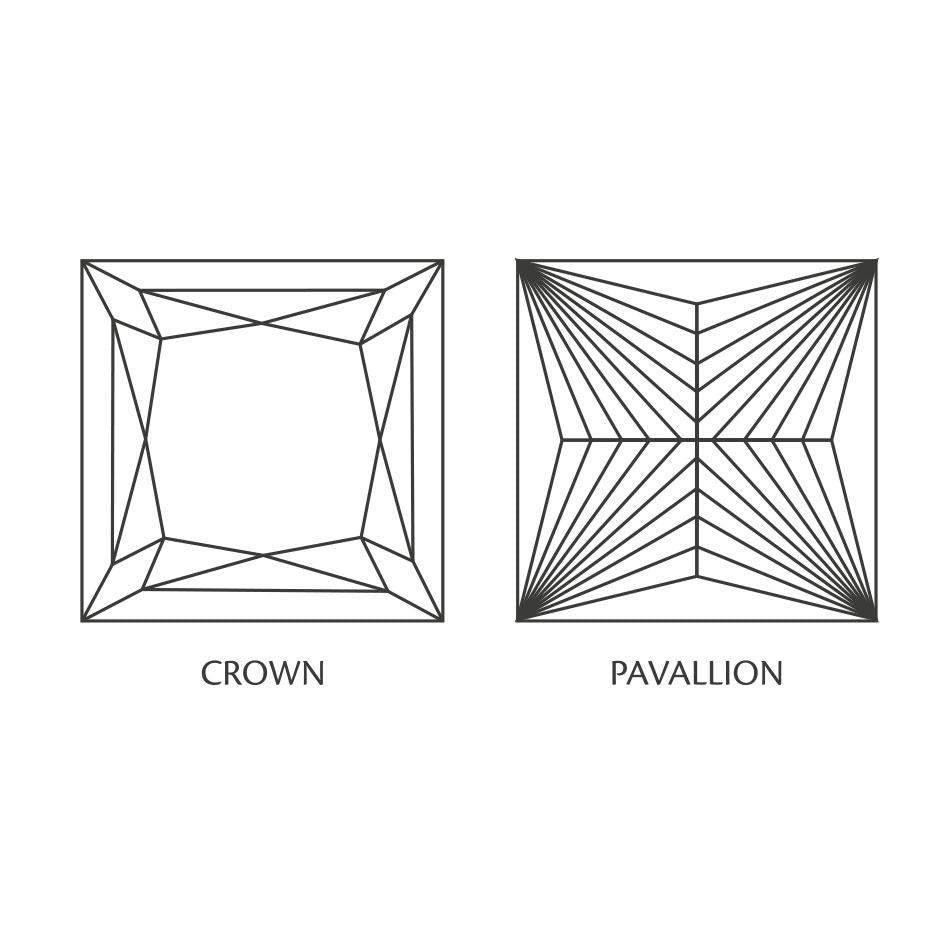
- Crown — the upper section, viewed from above and containing the table.
- Girdle — the boundary separating crown and pavilion.
- Pavilion — the lower section, which converges toward the culet.
The conventional round brilliant is highly symmetrical, but the mathematical structure of a diamond does not have to stop there.
The research treats a diamond as a convex polyhedron — essentially a three-dimensional object made from flat polygonal faces.
This changes the question completely.
Instead of asking:
“What should the next diamond shape look like?”
the researchers ask:
“What arrangements of faces are mathematically possible while still producing a valid three-dimensional diamond structure?”
That distinction is important because the study is not primarily about determining the ideal proportions of a diamond.
It focuses on the abstract arrangement of facets.
Measurements such as table size, facet angles, diameter and depth are deliberately set aside. Once a valid faceting arrangement has been identified, proportions can become a separate design problem.
In other words, the research is concerned with the architecture of a cut before its dimensions are optimised. gia
Why Symmetry Makes the Problem More Manageable
If mathematicians attempted to enumerate every conceivable polyhedron, the number of possibilities would become enormous.
Most would also be irrelevant to jewellery.
A gemstone cutter does not simply want any mathematical polyhedron. The object must have an appropriate outline, a usable crown and pavilion, a coherent girdle and a physically plausible three-dimensional structure.
Symmetry provides a powerful way to reduce this enormous search space.
The study focuses particularly on dihedrally symmetric diamonds.
A dihedral symmetry combines:
- Rotational symmetry
- Reflectional symmetry
Imagine looking directly down at a symmetrical diamond. Instead of analysing the entire circular or polygonal pattern, you can divide it into repeated sectors.
One sector contains the essential information.
Reflect and rotate that sector repeatedly, and the complete faceting arrangement is generated.
This smaller section is called a fundamental domain.

The Fundamental Domain: A Blueprint for the Entire Diamond
The concept of the fundamental domain is one of the most elegant parts of the research.
Imagine a diamond whose top view can be divided into eight identical sectors.
Instead of drawing every facet around the entire stone, a designer can focus on just one sector.
The edges and vertices inside this sector form what the researchers call a generating graph.
Once the generating graph has been validated, symmetry can reproduce it around the entire stone.
This means that a complicated faceting pattern can effectively be reduced to a much smaller mathematical blueprint.
The researchers show that, for the dihedral symmetry groups considered, a generating graph can be used to construct diamonds with different symmetry orders. Their Theorem 3 leads to the surprising conclusion that the abstract set of facet arrangements is effectively independent of the specific dihedral order for orders of at least three.
That means the same underlying combinatorial pattern can generate different symmetric diamond configurations simply by changing the angular width of the fundamental sector.
For diamond designers, this is an intriguing concept: the same design logic can potentially be scaled across different symmetry systems without changing its underlying graph structure.
Explore our curated collection of GIA certified diamonds or learn more through our Diamond Education Guide.
Crown and Pavilion: Two Separate Design Problems
The researchers do not attempt to solve the entire diamond at once.
Instead, they divide it into two major components:
The Crown
The crown is the upper portion of the diamond, including the table and surrounding facets.
The Pavilion
The pavilion is the lower portion, extending toward the culet.
This separation reflects how diamond cutting itself is structured.
A crown and pavilion with compatible outlines can be paired to form a complete diamond, while the vertical offset between them becomes an additional geometric parameter.
This also makes the enumeration problem much more manageable.
Rather than searching through every possible three-dimensional diamond, the algorithm can ask:
- What crown structures are possible?
- What pavilion structures are possible?
- Can each structure exist as a valid three-dimensional convex form?
- Which crown and pavilion combinations can be paired?
The result is a systematic approach rather than relying on intuition or manually drawn concepts.
Turning a Facet Diagram into a Three-Dimensional Diamond
A particularly fascinating part of the research is the transition from two-dimensional graphs to three-dimensional geometry.
A graph can show vertices and connections between them, but a diamond obviously exists in three dimensions.
So the researchers need to determine whether a planar graph can be assigned different heights — or z-coordinates — so that its faces become valid planar facets.
Such a structure is called a truss in the paper.
For a graph to become a valid convex diamond component, it must satisfy important mathematical conditions.
The outer boundary needs to be convex, while the resulting facets must meet in the appropriate “mountain” configuration rather than producing invalid folds.
This is where the Maxwell-Cremona correspondence becomes important.
The correspondence provides a mathematical bridge between a planar graph with appropriate equilibrium properties and a three-dimensional polyhedral structure.
In simplified terms:
2D graph → valid planar embedding → geometric lift → 3D convex structure
This is one of the key reasons the study is more than a theoretical catalogue of drawings. The algorithm attempts to establish that the abstract facet arrangement can actually correspond to a plausible three-dimensional structure.

✨ Explore Diamond Options Designed to Last
Speak with our team on WhatsApp
or Book a private consultation in Hong Kong
Tutte Embedding: Using “Springs” to Test Diamond Geometry
One of the central computational tools used in the research is the Tutte embedding.
The idea is surprisingly intuitive.
Imagine the edges of a graph as springs connecting points together.
The outer boundary is fixed in a convex shape, while the interior vertices are allowed to move until the spring forces reach equilibrium.
Mathematically, this produces a particular planar embedding of the graph.
If the resulting graph remains properly embedded without unwanted intersections or collapses, it can provide evidence that the graph is planar and suitable for further analysis.
The researchers then combine this with tests for boundary triconnectivity.
Why is that important?
Because a diamond needs structural integrity. If removing one or two critical vertices causes the graph to fall apart in the wrong way, the arrangement cannot represent the required convex polyhedral structure.
The study therefore uses graph theory as a filter:
Generate → test connectivity → test planarity → test triconnectivity → lift into 3D
Only structures that survive these stages remain candidates.
From Thousands of Possibilities to Plausible Diamond Cuts
The computational challenge becomes particularly interesting when the algorithm starts generating possible graphs.
A fundamental domain can contain several types of vertices.
The researchers classify them according to their position:
- L vertices — positioned along the left wall
- M vertices — positioned in the middle
- R vertices — positioned along the right wall
There can also be boundary vertices and, for pavilion structures, a central vertex corresponding to the culet.
The algorithm then considers possible connections between these vertices.
At first, this produces many potential combinations.
Most are eliminated.
Some are disconnected.
Some are duplicates of another arrangement under a different labelling.
Others fail planarity.
Others fail triconnectivity.
Still others cannot be lifted into an appropriate three-dimensional truss.
This is where computation becomes particularly useful. A human designer could intuitively generate a handful of interesting patterns, but an algorithm can systematically explore an enormous combinatorial space without assuming in advance what a “beautiful” diamond should look like.

Simple and Standard Diamond Cuts
For the main enumeration, the researchers focus on two categories of dihedrally symmetric designs.
Simple
A simple design has a single exterior vertex within the fundamental domain.
The princess-style example discussed in the study falls into this category.
Standard
A standard design has two exterior vertices, one associated with each wall of the fundamental domain.
The standard round brilliant provides the familiar example.
There can be additional boundary vertices in more complex outlines, such as certain marquise or cushion configurations, but the study restricts the principal enumeration to simple and standard cases.
This restriction is important.
The paper is not claiming to enumerate every imaginable diamond design, including every asymmetric or non-convex shape.
Instead, it creates a rigorous framework for a defined and mathematically tractable class of dihedrally symmetric simple and standard diamond cuts.
The Surprising Independence of Symmetry Order
One of the most interesting conclusions is that the underlying generating graph can be independent of the exact order of dihedral symmetry, provided the order is at least three.
In practical terms, imagine that a generating graph is designed inside one sector.
That same graph can then be interpreted inside a narrower or wider sector to create different symmetry orders.
This produces a mathematical relationship between designs that might look quite different when viewed as finished diamonds.
The significance is subtle but powerful:
A diamond's visible symmetry can change while the underlying combinatorial architecture remains the same.
For researchers and designers, this creates a way to classify families of cuts rather than treating every finished appearance as an entirely separate invention.
Why the Research Matters for Diamond Design
At first glance, enumerating graphs may seem far removed from luxury jewellery.
In reality, the research touches a fundamental problem in diamond design:
How large is the universe of possible cuts?
The jewellery industry already has a remarkable vocabulary of shapes and facet arrangements. Round brilliant, princess, emerald, cushion, oval, pear, marquise and other cuts represent only a portion of the possible design landscape.
But there is a difference between inventing a shape and understanding whether its facet architecture is mathematically valid.
A computational enumeration framework could eventually help designers explore unfamiliar arrangements more systematically.
Rather than beginning with:
“Can I draw something that looks interesting?”
the process could become:
“Which valid facet architectures have not yet been explored?”
That shift could be particularly valuable in bespoke and high jewellery, where designers increasingly look for individuality beyond established commercial cuts.

✨ Explore Diamond Options Designed to Last
Speak with our team on WhatsApp
or Book a private consultation in Hong Kong
Why Proportions Still Matter
The research makes an important distinction between faceting arrangement and proportion optimisation.
Finding a valid arrangement does not automatically make it a beautiful or high-performing diamond.
Once a faceting class has been identified, designers still need to determine factors such as:
- Table size
- Crown height
- Pavilion depth
- Facet angles
- Girdle geometry
- Length-to-width ratio
- Overall depth
- Weight retention
- Optical performance
These parameters can dramatically affect how a diamond handles light.
This is why the mathematical enumeration should be seen as a foundation, rather than a replacement for gemological and cutting expertise.
The research itself notes that optimisation of proportions is a separate and significant area of diamond-cut research.
From Mathematics to the Diamond Cutter's Bench
There is also a practical side to the research.
Modern diamond cutters already use sophisticated software and instrumentation to evaluate rough stones, simulate cutting and optimise yield and proportions. The GIA study notes commercial tools from companies including Sarine, Octonus and Lexus SoftMac.
The new mathematical framework approaches the problem from another direction.
Instead of asking how to optimise a known design, it asks:
What designs are mathematically available in the first place?
That distinction could become increasingly relevant as computational design, CAD and digital modelling become more deeply integrated into high-end jewellery production.
A designer could theoretically begin with an abstract facet architecture, translate it into a three-dimensional model, optimise its proportions and then evaluate its optical behaviour.
The pipeline becomes:
Mathematical architecture → CAD model → proportion optimisation → optical analysis → physical cutting
For bespoke jewellery, this represents an exciting bridge between mathematical research and craftsmanship.
The Future of Diamond Cutting May Begin With a Graph
Perhaps the most fascinating idea behind the research is that a diamond can be described before it exists physically.
A sequence of vertices and edges can encode a faceting arrangement.
Symmetry can replicate that arrangement.
Graph theory can determine whether the structure is viable.
Tutte embedding can help establish a planar representation.
Maxwell-Cremona correspondence can lift the structure into three dimensions.
Only after all of this does the familiar diamond emerge.


What This Means for the Future of Bespoke Diamonds
For collectors and jewellery clients, the most immediate consequence may not be a sudden appearance of hundreds of new diamond shapes.
The deeper significance is the possibility of systematic design discovery.
Traditional diamond cutting has evolved through centuries of experimentation, craftsmanship and accumulated knowledge. Mathematical enumeration offers another tool: the ability to search the design space methodically rather than relying entirely on historical precedent.
This could be particularly compelling for bespoke jewellery.
A client looking for a one-of-a-kind diamond could eventually move beyond choosing between established cuts and instead explore a broader family of mathematically valid faceting architectures.
The result would not simply be a different outline.
It could be a genuinely different facet language.
For Mangrove Diamonds, this perspective aligns naturally with the philosophy behind custom jewellery design: the idea that a finished jewel can be developed around a client's preferred proportions, gemstone characteristics and design intention rather than being restricted to a predetermined template.
A New Way to Think About the Diamond Cut
The diamond cut is often described through measurements: proportions, angles, symmetry and facet counts.
But the research of Jim Conant suggests another layer beneath those measurements.
Before we ask how large a table should be or what pavilion angle produces the desired optical behaviour, we can ask a more fundamental question:
What facet arrangements are possible at all?
By combining symmetry, graph theory, Tutte embeddings and three-dimensional lifting, the study creates a systematic framework for exploring that question.
And perhaps that is the most exciting implication for the future of diamond design.
The next important diamond cut may not begin with a sketch of a gemstone.
It may begin with a graph.
Explore Diamonds Through Both Science and Design
For collectors and clients interested in how cut, proportion and craftsmanship influence a diamond's final appearance, explore Mangrove Diamonds' diamond collection or discuss a bespoke concept with the team.
In modern diamond design, mathematics can define what is possible — while craftsmanship, proportion and the human eye determine what becomes beautiful.
Read more

Red & Orange Spinel from Myanmar and Vietnam: How Science Reveals Colour, Origin and Rarity
Among the world’s exceptional coloured gemstones, spinel has undergone a remarkable transformation in perception. Once frequently mistaken for ruby in historic jewellery, fine spinel is now appreci...
Read more