A gemstone's beauty is often revealed through its colour, transparency and carefully fashioned facets. Yet some of the most fascinating gems are distinguished by features hidden within their interiors.
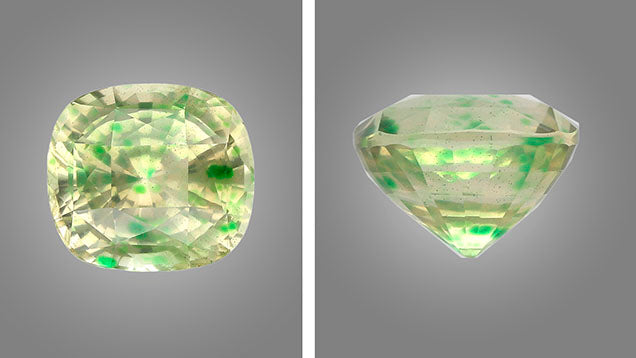
A remarkable example is a 5.09-carat grossular garnet examined by the Laboratoire Français de Gemmologie (LFG). At first glance, the cushion-cut gemstone displays a slightly yellowish-green body colour. Look closer, however, and vivid green, nearly spherical formations appear throughout the stone, each resembling a tiny halo suspended within the crystal.
These unusual inclusions transform an otherwise understated gemstone into a compelling collector's specimen. Their distinctive appearance, possible geological origin and unusual distribution make this grossular garnet a fascinating subject in modern gemological research.

A Cushion-Cut Gemstone with Unusual Green Halos
The gemstone submitted to LFG weighed 5.09 carats and measured 9.86 mm at its longest dimension.
Its most striking feature was a series of bright green internal spots. Under magnification, the spots revealed nearly spherical shapes, clearly defined borders and a grainy internal texture.
At least two of the green halos contained a dark inclusion at their centre. In other spots, a similar central core may have been present but concealed beneath the relatively opaque green material.
The green zones also displayed slight birefringence when examined between crossed polarizers, an observation that provided additional insight into their internal structure.
Together, these features create an unusual visual effect: dark central points surrounded by vivid green halos, set within a lighter green gemstone.
✨ Explore Diamond Options Designed to Last
Speak with our team on WhatsApp
or Book a private consultation in Hong Kong
Identifying the Gemstone: Grossular Garnet
Before investigating the inclusions, the gemologists needed to establish the identity of the host gemstone.
The stone's refractive index of 1.735 and specific gravity of 3.53 were consistent with grossular garnet. Its identity was further confirmed through vibrational spectroscopy.
Raman analysis revealed two principal peaks at approximately 881 and 375 cm⁻¹, characteristic of grossular. Infrared transmission spectroscopy also supported the identification.
Chemical analysis detected silicon, calcium and aluminium as the principal components, consistent with the chemical composition of grossular:
Ca₃Al₂(SiO₄)₃
Minor elements included magnesium, iron, chromium and manganese.
Although these trace components were present in relatively small quantities, chromium was particularly important to understanding the gemstone's vivid green internal features.
For further background on garnet varieties and their gemological characteristics, readers can explore the GIA Garnet Gemstone Guide.
Chromium and the Origin of the Green Colour
The green colour of the grossular was attributed most likely to chromium in its Cr³⁺ state.
This interpretation was supported by the chemical detection of chromium and by comparison with other chrome-bearing grossular garnets displaying a similar colour.
Chromium is known to contribute to the green appearance of certain garnet varieties. In this particular specimen, however, the element's distribution is especially intriguing.
Rather than producing an entirely uniform colour, chromium appears to be concentrated within distinct, nearly spherical zones.
The result is a gemstone whose visual character is defined not only by its overall body colour, but also by the contrast between its pale green host and the brighter internal halos.
✨ Explore Diamond Options Designed to Last
Speak with our team on WhatsApp
or Book a private consultation in Hong Kong
Jeffrey Mine: A Rare Geological Connection
The green halo pattern is associated with grossular garnets from the Jeffrey mine in Val-des-Sources, formerly known as Asbestos, in southeastern Québec, Canada.
According to the published literature cited by the researchers, this is the only locality known to produce grossular with green patches or spherical halos of this distinctive type.
Earlier specimens from the locality were described as having dark central inclusions identified as chromite, a chromium-bearing mineral with the chemical formula:
Fe²⁺Cr₂O₄
The presence of chromite provides a plausible explanation for the chromium associated with the surrounding green zones.
This connection makes the Jeffrey mine particularly significant to collectors and mineral enthusiasts interested in unusual garnet formations.
The locality is not simply a geographic detail. It provides an important clue to the geological processes that may have produced the gemstone's distinctive internal appearance.
A Curious Pattern: Multiple Green Halos
One of the most unusual aspects of the examined grossular is the presence of multiple green halos.
Earlier specimens described in the literature generally displayed a single central spot. The 5.09-carat gemstone, by contrast, contains several distinct green formations.
This difference adds to the specimen's rarity and visual complexity.
The researchers proposed that chromium may have leaked or diffused from the central dark inclusion—presumed to be chromite—into the surrounding grossular, creating the green halo.
However, no established theory currently explains the precise geometric distribution of these formations.
The pattern remains an intriguing subject for further study, illustrating how mineral growth and chemical interactions can produce unexpected structures within natural gemstones.
Why the Green Zones Are Not Classified as Uvarovite
Although chromium is associated with the vivid green colour, the green halos cannot simply be classified as uvarovite garnet.
The highest chromium concentration measured in one of the green zones was below 9 wt.% Cr₂O₃. This corresponds to approximately 25 wt.% uvarovite component, which is insufficient for the green zone to be identified as uvarovite according to the cited research.
This distinction is important in gemology.
A gemstone's colour may be influenced by a particular chemical element without changing its fundamental mineral identity. In this case, the host remains grossular garnet, while the chromium-rich zones contribute to its unusual appearance.
The result is a natural gemstone whose visual character reflects a complex internal distribution of chemical components rather than a simple change in mineral species.

A Collector Gem Defined by Its Inner Structure
The appeal of this grossular garnet lies in the combination of several unusual characteristics:
-
A faceted cushion-cut gemstone weighing 5.09 carats
-
A slightly yellowish-green body colour
-
Multiple bright green, nearly spherical halos
-
Dark central inclusions, presumed to be chromite
-
A distinctive geological association with the Jeffrey mine
-
An internal pattern that remains incompletely explained
The gemstone demonstrates that collector interest is not always determined by conventional quality factors alone.
For certain specimens, rarity, provenance, unusual inclusions and scientific significance can be just as compelling as colour or clarity.
At Mangrove Diamonds, we appreciate gemstones not only for their polished appearance, but also for the natural stories preserved within them. This grossular garnet is a striking example of how an unusual internal feature can become the defining characteristic of a gemstone.
Explore our jewellery collection or learn more about our custom jewellery service to discover how distinctive gemstones can inspire individual designs.
The Beauty of a Gemstone's Hidden World
The 5.09-carat grossular garnet with green halo inclusions offers a fascinating glimpse into the complexity of natural gemstone formation.
Its vivid green spots, dark central cores and unusual multi-halo pattern distinguish it from more familiar garnet specimens. The likely role of chromium and the possible association with chromite provide clues, while the precise mechanism behind the halos remains unresolved.
For gemologists, the stone presents an intriguing scientific question. For collectors, it represents the appeal of a gemstone whose individuality is preserved within its crystal structure.
Sometimes, the most extraordinary feature of a gemstone is not what catches the eye at first glance, but what becomes visible only when we look deeper.