Diamonds are admired for their remarkable hardness, optical brilliance and highly ordered crystal structure. Inside these gemstones, inclusions and internal features can reveal fascinating details about their natural formation. While many diamond inclusions appear angular, linear or sharply defined, some display unusual shapes that challenge what gemologists typically expect to see.
One particularly intriguing example is the discovery of delicate, hair-like loops inside a natural diamond. Resembling the distinctive horsetail inclusions found in demantoid garnet, these unusual formations create a striking contrast with the predominantly straight-edged internal features commonly associated with diamond.
Documented by the Gemological Institute of America (GIA), this observation offers a closer look at the complexity of diamond interiors and the geological processes that can influence their crystal structure.
✨ Explore Diamond Options Designed to Last
Speak with our team on WhatsApp
or Book a private consultation in Hong Kong
A Rare Discovery Inside a Natural Diamond
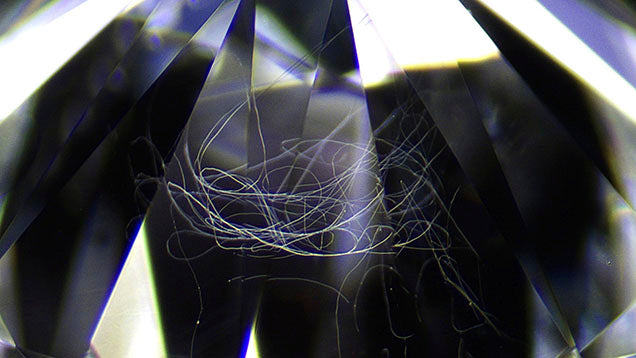
The GIA researchers recently examined a 0.57-carat round brilliant natural diamond with a J colour and SI1 clarity grade.
What made this particular stone remarkable was not its external appearance, but a rare internal formation consisting of delicate, hair-like loops.
The inclusion was most clearly visible when the diamond was examined through its pavilion under a microscope. Its curved, looping appearance was unusual for a mineral whose internal structural features are generally characterised by angular shapes and relatively straight boundaries.
The researchers compared the formation to the horsetail-like fibrous inclusions commonly associated with demantoid garnet.
This resemblance is especially interesting because it highlights how different gemstones can display visually similar internal patterns, even though their crystal structures and geological characteristics are distinct.
The discovery demonstrates that diamond inclusions can exhibit more complex forms than the conventional angular and linear features often encountered during gemological examination.

Why Are Hair-Like Loops Unusual in Diamond?
To understand the significance of this discovery, it is important to consider the structure of diamond itself.
Diamond is a monocrystalline material, meaning its atoms are arranged in an organised, continuous crystal lattice. This highly ordered structure contributes to its exceptional physical properties.
Because of this arrangement, many internal features observed in diamonds tend to appear angular or straight-edged. Clearly curved structural formations are comparatively uncommon.
The hair-like loops documented by GIA therefore stand out as an unusual feature within the diamond's otherwise ordered crystalline structure.
Rather than representing a typical mineral inclusion with a clearly defined angular outline, these delicate loops appear to follow a curved, fibrous pattern.
Their unusual geometry raises an interesting question: what processes can produce such distinctive internal structures within a diamond?
Plastic Deformation: How Diamonds Change Beneath the Earth's Surface
One explanation discussed by the researchers involves plastic deformation.
Although diamond is exceptionally hard, it can still undergo deformation under the geological conditions found deep within the Earth.
Plastic deformation occurs when a crystal experiences changes in its internal structure under stress. Unlike elastic deformation, which allows a material to return to its original shape after the stress is removed, plastic deformation can leave lasting structural changes.
In diamonds, linear surface graining and internal graining are recognised manifestations of this process.
These features provide evidence that the crystal has experienced deformation during its geological history.
The presence of unusual internal structures, such as the hair-like loops, offers another reason to examine how deformation may influence the development and arrangement of structural defects within diamond crystals.
Dislocations: The Microscopic Defects Behind Crystal Complexity
A key concept in understanding the formation of these unusual features is the presence of crystal dislocations.
A dislocation is a type of linear defect within a crystal lattice. It represents a local disruption in the otherwise orderly arrangement of atoms.
Dislocations are important in mineral crystallography because they influence how crystals deform and how their internal structures develop.
According to the GIA discussion, two processes during diamond growth can contribute to an increase in dislocation density:
-
Plastic deformation: Geological stress can alter the crystal structure and generate dislocations.
-
Precipitation of microscopic foreign matter: Tiny particles deposited on growing crystal surfaces may also contribute to an increase in dislocation density.
The researchers further noted that the presence of one dislocation may encourage the development of additional dislocations.
This relationship helps explain why the internal structure of a natural diamond can become more complex during its formation and subsequent geological history.
However, the precise mechanism responsible for producing the particular hair-like loops in the examined diamond remains an important point of investigation. The observation provides a compelling example of unusual internal morphology, rather than a complete explanation of every stage of its formation.
✨ Explore Diamond Options Designed to Last
Speak with our team on WhatsApp
or Book a private consultation in Hong Kong
A Visual Connection to Demantoid Garnet
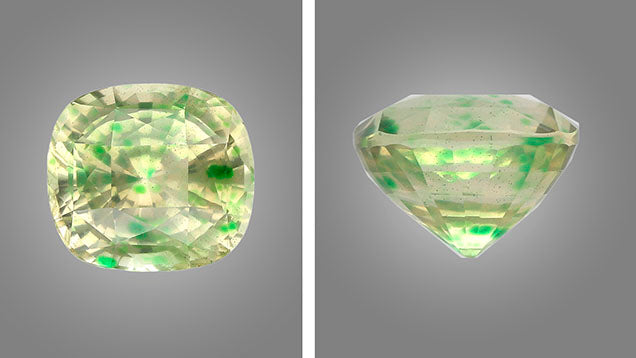
One of the most fascinating aspects of the discovery is its resemblance to the horsetail inclusions found in demantoid garnet.
Demantoid is a green variety of andradite garnet, admired for its brilliance and distinctive internal features. Some specimens display fine, fibrous inclusions arranged in characteristic horsetail patterns.
These formations are often considered among the most recognisable visual characteristics associated with demantoid garnet.
The hair-like loops observed in diamond evoke a similar visual impression, despite occurring in a very different gemstone.
This comparison highlights an important aspect of gemology: inclusions are not merely imperfections. They can also provide valuable information about a gemstone's internal structure and geological history.
In some cases, unusual inclusions become distinctive identifying characteristics that make a specimen particularly interesting to gemologists and collectors.
What This Discovery Tells Us About Natural Diamonds
The hair-like loop formation is a reminder that natural diamonds are not always as structurally simple as their familiar appearance might suggest.
Even within a highly ordered monocrystalline material, geological stress, crystal growth processes and the development of dislocations can produce unusual internal characteristics.
For gemologists, such observations expand the understanding of diamond inclusions and demonstrate the importance of microscopic examination.
For collectors and jewellery enthusiasts, they offer another perspective on the individuality of natural diamonds. Each stone carries a geological history, and its internal features may reveal details that remain invisible during ordinary viewing.
At Mangrove Diamonds, we believe that understanding a diamond goes beyond its brilliance and outward appearance. Its natural characteristics, clarity features and internal structure all contribute to what makes each gemstone distinctive.
Explore our diamond collection or discover our jewellery collection to explore the beauty of diamonds through a deeper appreciation of their natural characteristics.
✨ Explore Diamond Options Designed to Last
Speak with our team on WhatsApp
or Book a private consultation in Hong Kong
The Beauty of What Lies Within
The discovery of hair-like loops in a natural diamond offers a fascinating example of the complexity hidden within one of nature's most celebrated gemstones.
Resembling the horsetail inclusions of demantoid garnet, these unusual curved formations stand apart from the angular and linear features typically associated with diamond interiors.
By considering plastic deformation, crystal dislocations and the processes occurring during diamond growth, researchers gain further insight into how geological conditions can influence a crystal's internal architecture.
Ultimately, a diamond's story is not written only in its facets. Sometimes, its most remarkable details are found deep within the stone itself.
Discover the natural character of diamonds with Mangrove Diamonds. Explore our collection or contact our team to discuss a diamond and jewellery design that reflects your personal taste.